S’bo Gyre has just released a song about quitting his job and built an entire world around it.
There is the song, I Quit (9.2.5) which he wrote in 2022 while frustrated with working life. There is the fact that he actually resigned from his job before releasing it. There is the resignation-style press release. There are the office performances, street promotions, corporate wardrobe and increasingly elaborate ways he has found to put the audience inside the story.

Even the rollout behaves like a character.
S’bo has created a world for us to get inside the mind of the employee who has had enough, and every new piece of content gives us another glimpse into what happens when that employee decides to take the joke seriously.
The single was released on 18 September 2026, with Yolophonik and Audio Addicts, and the release has already developed into something much bigger than a conventional music campaign.
The song has become real life
The premise works because S’bo eventually did the thing the song talks about.
He wrote I Quit in 2022, inspired in part by the feeling of being stuck in a nine-to-five and the effect Beyoncé’s Break My Soul had on him at the time.
For years, he joked that whenever he released the song, he would have to quit his own job. Then he did.
The decision gives the song an unusually literal backstory. S’bo has explained that he eventually resigned from his position as PR lead at Writersbloc, where his communications career had included major campaigns, to put more of his energy into his own creative work.

That detail could have been enough to build a press cycle around. Instead, S’bo seems to have asked a more interesting question: what if the resignation became the entire creative language of the release? That is where I Quit starts to become a world.
The resignation letter is part of the joke
Even the press release plays along.
Instead of treating the song as a standard release announcement, the communication adopts the language of a resignation.
We are no longer just being told that a musician has a new single. We are being invited into an office drama. There is an employee. There is a job. There is a resignation. There is an exit.
And then there is the music. It is a small distinction, but an important one. The campaign does not just explain the concept to us. It performs the concept. That becomes the organising principle for everything that follows.
Then he takes the office to the robots
The street promotion might be the clearest example.
S’bo has been taking the song to traffic lights and standing alongside the road with a cardboard sign and a QR code, asking passing motorists to stream the track.
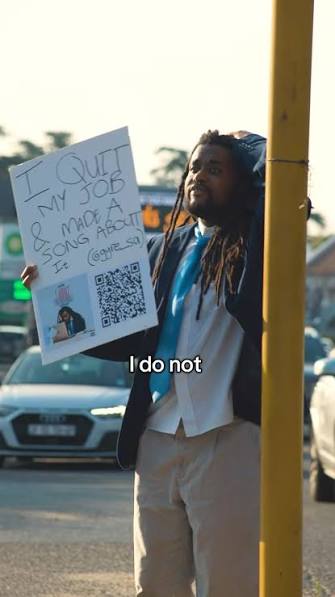
The visual joke is immediately recognisable because people standing at robots with signs are usually asking for work, money or an opportunity. S’bo is asking for something. He just wants you to stream his song.
It turns a familiar Johannesburg street scene into another chapter of the I Quit story. The unemployed-looking figure at the robot is actually an artist actively promoting his new job: making music.
There is something particularly effective about the literalness of it. Instead of explaining the concept through a caption, he physically places himself in situations where the joke can be understood in a few seconds.
The sign becomes part of the character. The robot becomes part of the set. The QR code becomes part of the plot. And the person driving past becomes an audience member. The office content makes the audience part of the fantasy
Then there are the videos of S’bo in offices, simply vibing with people to the song. On the surface, they are promotional clips. But within the larger campaign, they start to feel like scenes. People at work hear I Quit. They dance to it. They laugh with him. They become part of the story. There is almost a vicarious quality to these moments. S’bo has done the thing that many people fantasise about doing, and now he is walking into their workplaces carrying the soundtrack.
For a few minutes, everybody gets to participate in the fantasy. That is particularly useful for a song about quitting because the audience does not have to actually quit anything to understand the feeling. They can still be sitting at their desks, answering emails and waiting for lunch while briefly inhabiting S’bo’s version of freedom.
The content keeps the joke alive without having to repeat the same message every time.
Even the clothes are doing narrative work
Then there is the wardrobe.
Since the song dropped, S’bo has repeatedly appeared in variations of the corporate uniform: shirt, tie, blazer. It is simple, but it makes the concept immediately legible.

He looks like someone who has just come from the office. Or someone who is about to leave it. Or someone who is still technically at work while mentally being somewhere else entirely. That ambiguity is useful because it keeps him suspended between two versions of himself.
The employee is still visible. The artist is taking over. Rather than treating fashion as a separate visual exercise, the clothing keeps reinforcing the same character every time he appears. The tie becomes part of the logo without actually being a logo. The blazer becomes a prop. The office uniform becomes costume. And suddenly, S’bo can walk into almost any piece of content and we already understand the scene.
This is where his PR background becomes part of the art
There is another layer to the campaign that makes the consistency particularly interesting.
S’bo already knows how campaigns work. His professional background is in PR and communications. He has spent years thinking about messaging, audiences, positioning and how an idea travels from one piece of communication to another.
With I Quit, those skills are no longer being applied to someone else’s campaign. They are being applied to himself.
S’bo has described the meeting point between his PR experience and his music as part of his performance practice. His comments to the Mail & Guardian make that relationship particularly clear: the older version of his rollout might have been a conventional press release, while his current approach gives him room to play with the tension between communications, music and performance.
That is exactly what makes this campaign feel unusually coherent. The PR is not sitting outside the artwork. The PR is helping construct it.
The rollout keeps giving us another scene
This is perhaps the smartest part of I Quit. S’bo could have made one funny video about quitting. He could have posted the resignation letter. He could have done the song in a suit. He could have performed it at an event and moved on.
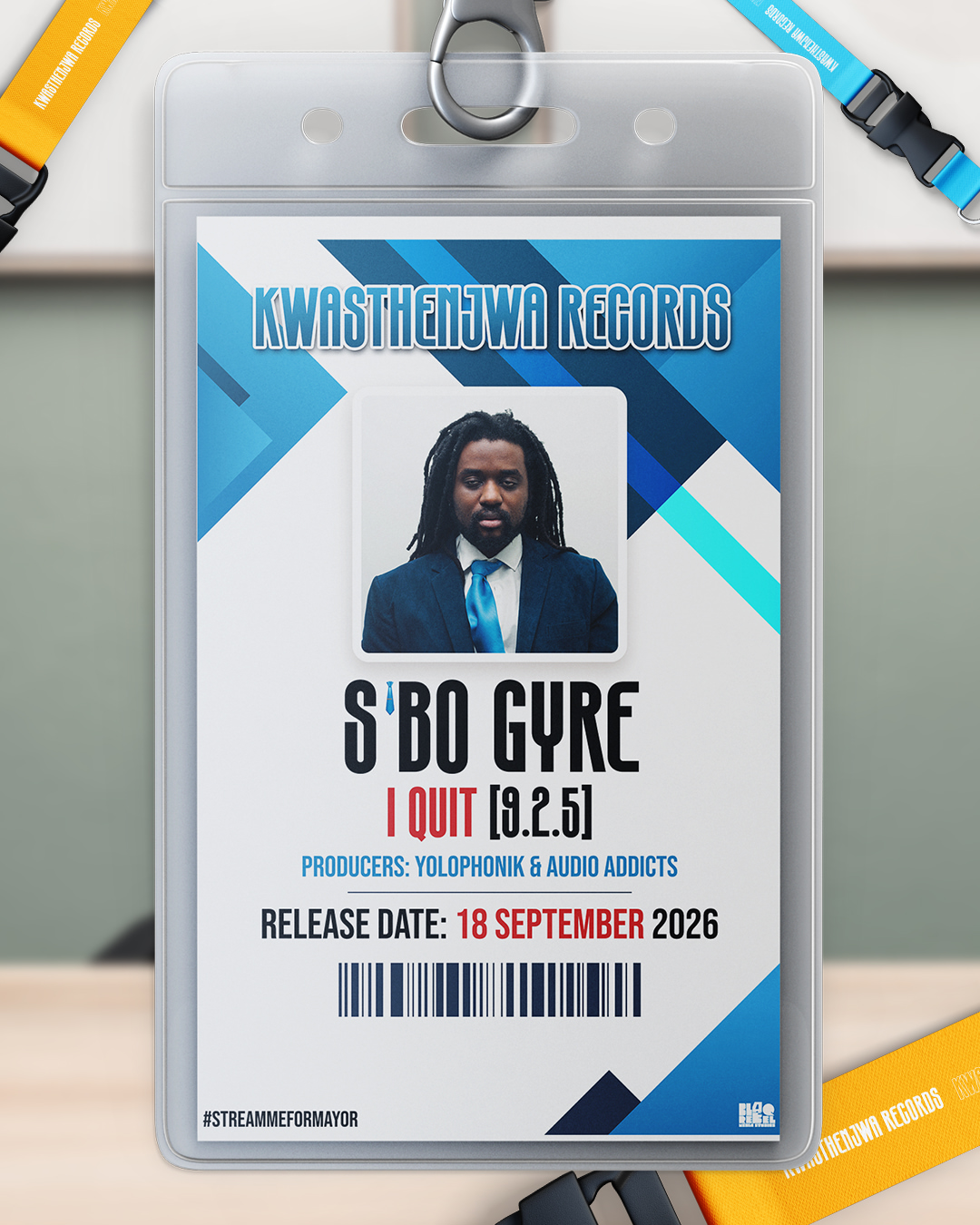
Instead, he keeps finding new situations in which the same idea can live. The street promotion changes the joke. The office content changes it again. The resignation press release gives it another layer. The wardrobe keeps the visual language intact. The live performances turn the audience into participants. And the song itself gives everything a soundtrack.
The result is a campaign where each individual piece can stand on its own, while also making more sense because you have seen the pieces before it. You start recognising the character. You start understanding the visual cues. You start wondering where he is going to show up next. That is what keeps people engaged.
He is making the audience follow the story
There is a difference between a campaign that tells you what an artist is doing and one that gives you a reason to keep checking in. I Quit leans towards the second.
The audience is not given the entire story in one post. We get fragments. Here he is at the robot. Here he is in an office. Here he is performing. Here he is dressed like he is still employed. Here is another person dancing to the song. Here is another piece of resignation-themed content.
Each post adds another little piece to the same universe. It starts to resemble episodic storytelling. You do not need every post to explain itself because the previous posts have already established the rules. That is a powerful way to use social media, particularly for music.
Instead of treating every post as an isolated advertisement for the same song, S’bo gives the audience an ongoing narrative to follow.
The joke works because he commits to it
There is also a risk with a concept this literal. The first resignation joke is funny. The second time, you understand it. By the fifth or sixth piece of content, it could easily start feeling repetitive.
The reason it has not collapsed into one long gag is that S’bo keeps changing the setting while keeping the central idea intact.
He is consistent without being completely repetitive. The world has rules, but it still has room to move. The corporate wardrobe tells us who this character is. The resignation tells us what happened. The song tells us how he feels. The street promotions show us how far he is willing to take it. The office videos show us how other people respond to it. And the audience keeps becoming part of the story.
From marketing campaign to performance
This is why it feels reductive to describe I Quit as simply a well-executed music rollout.
There is obviously marketing happening. S’bo wants people to hear the song, scan the QR code, watch the videos and share the content. But the campaign is also functioning as an extension of the creative work.
The song is about quitting. The artist actually quit. The press release behaves like a resignation. The wardrobe looks like corporate life. The street promotion turns the search for work into a search for streams. The office content places the song back inside the environment he has just left. The whole thing keeps circling the same idea from different angles.
That is world-building. Not necessarily in the fantasy-world sense of constructing an elaborate fictional universe, but in the sense of creating a set of recognisable rules, images, behaviours and situations that all belong to the same story.
And S’bo has been remarkably disciplined about staying inside those rules.
He is selling us the fantasy while living it
There is something else that gives the campaign its pull. S’bo is not asking the audience to imagine some completely fictional character who quits a job. He actually did it.
That makes every piece of content slightly more believable and slightly more ridiculous at the same time. The person at the robot with the QR code really did leave salaried employment. The guy dancing in offices really did leave the office. The artist wearing the tie really did write a song about quitting before eventually quitting.
The resignation joke keeps getting backed up by real life. That is why the audience can play along. We know there is a real person underneath the character.
The world stays open
The most interesting thing about I Quit may ultimately be what happens when the initial joke runs out. Because S’bo has already created something that can keep producing scenarios.
If the concept is simply “I quit my job”, there is a limit to how many times you can announce that. If the concept is “what does life look like after you quit?”, suddenly there are many more possibilities.
The office becomes something he visits. The street becomes his new workplace. The audience becomes his colleagues. The song becomes his business card. Every performance becomes another episode. That is where the rollout transcends being a collection of promotional assets. The genius of I Quit’s rollout is that it is now a story about what happens after the exit.
S’bo Gyre wrote I Quit years before he actually left his nine-to-five. Now he is using the release to keep us inside that decision with every post, outfit, performance and traffic-light encounter. The clever part is that he has figured out how to make us keep watching what happens next.